Genesis 1:1: "In the Beginning" or "When God Began"?
Feb 5, 2026
TLDR:
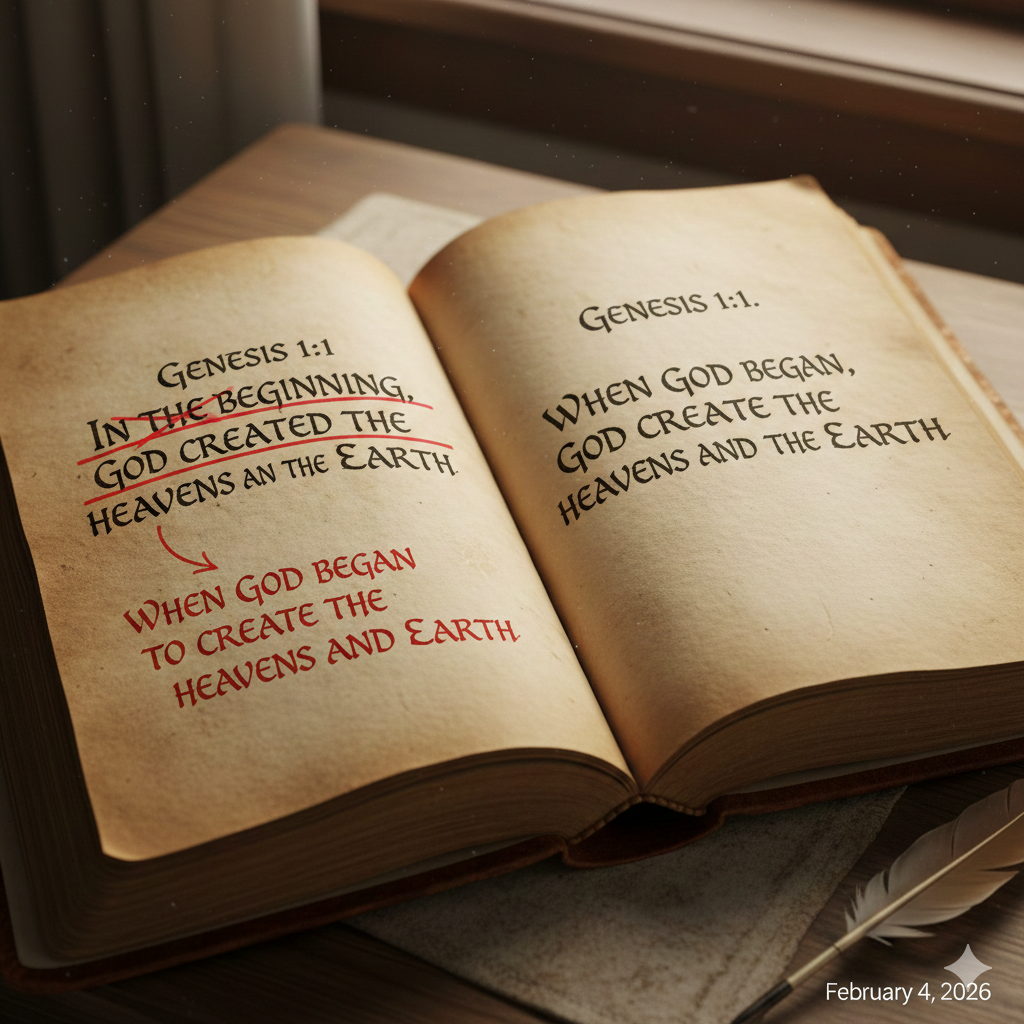
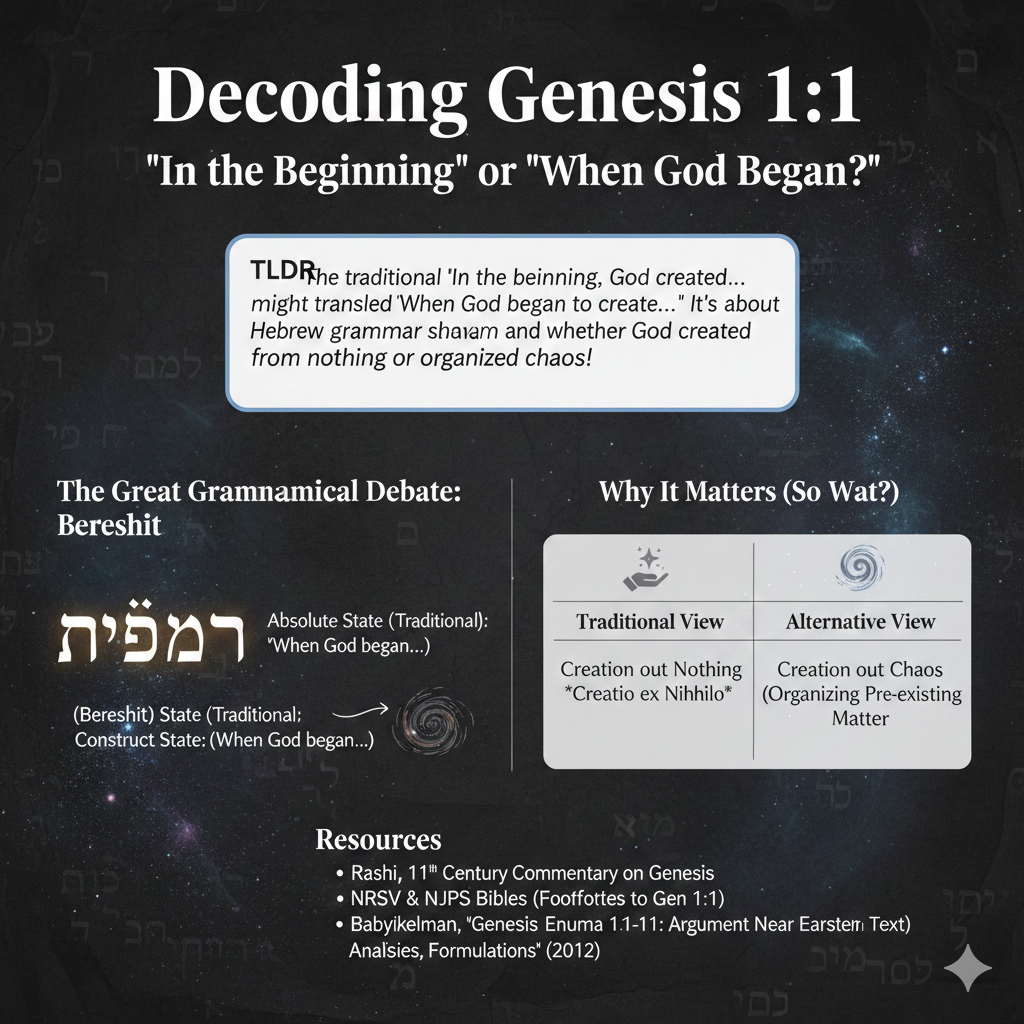
The traditional "In the beginning, God created..." (Genesis 1:1) might be better translated as "When God began to create...". This isn't just a nuance; it changes whether creation was out of nothing, or if God organized pre-existing chaos. It's all about Hebrew grammar!
The Great Grammatical Debate: Bereshit
The very first word of the Bible, בְּרֵאשִׁית (Bereshit), is at the heart of this ancient puzzle. Scholars debate whether this word is in the "absolute state" or the "construct state."
Absolute State (Traditional Reading): If Bereshit is absolute, it stands alone, confidently declaring, "In the beginning..." This implies a creation ex nihilo – out of nothing.
Construct State (Alternative Reading): If it's a construct, it functions like "In the beginning of..." In this case, it links directly to the following clause: "...God's creating of the heavens and the earth." This subtle shift suggests a relative beginning, where God is bringing order to something already present.
Why the "When God Began" Argument is Strong:
The Missing "The": Hebrew grammar often indicates an indefinite "beginning of" with the vowel under the first letter of Bereshit. If it truly meant "In the beginning," we'd expect a different vowel.
Ancient Near Eastern Parallels: Many creation narratives from cultures surrounding ancient Israel (like the Babylonian Enuma Elish) start with a "When... then..." structure. This contextual evidence suggests a common literary approach to origin stories.
Historical Scholarly Support: This isn't a new-age theory. Even prominent medieval Jewish commentators like Rashi (11th century) understood the grammar to imply: "In the beginning of God's creating... the earth was a formless void."
Why It Matters (So What?)
The translation of Genesis 1:1 isn't just an academic exercise; it has significant theological and philosophical implications:
Creation Ex Nihilo vs. Creation from Chaos:
Traditional View ("In the beginning..."): Suggests God created everything from absolute nothingness (creatio ex nihilo).
Alternative View ("When God began..."): Implies God brought order and form to pre-existing, perhaps chaotic, matter (the "formless void" mentioned in Genesis 1:2). This doesn't lessen God's power, but redefines the nature of the initial act.
The Role of Genesis 1:1: In the alternative reading, Genesis 1:1 acts as a dependent clause, setting the stage for the actual creative acts described from verse 3 onwards ("Let there be light"). It becomes a preface rather than a standalone statement of ultimate origin.
Resources & Links
The NRSV Translation: See the footnote on Verse 1 for the "When God began" alternative.
Sefaria: Rashi on Genesis 1:1: Read the 11th-century argument for why "Bereshit" should be read as "In the beginning of..."
Berlin, A., & Brettler, M. Z. (2014). The Jewish Study Bible. Oxford University Press. (Specifically the commentary on Gen 1:1-3 regarding the construct state of Bereshit).
Heidel, A. (1951). The Babylonian Genesis: The Story of Creation. University of Chicago Press. (Analysis of the "When... then..." linguistic parallels).
Holmstedt, R. D. (2008). "The Relative Clause in Biblical Hebrew." Society of Biblical Literature. (Technical linguistic proof for the "When God began" translation).
Rashi (Rabbi Shlomo Itzhaki).Commentary on the Torah. c. 1070–1105. (The primary historical source arguing that the grammar requires a "beginning of..." reading).
Waltke, B. K., & O'Connor, M. (1990). An Introduction to Biblical Hebrew Syntax. Eisenbrauns. (Standard reference for the "Absolute vs. Construct" state debate).